RCPS at EMNLP 2026: choosing document parsers by retrieval
Five months from a first draft to a Sunday night in Seoul: how a paper that started with our own OCR model reached EMNLP 2026, and the team's first virtual presentation.
Sunday 25 October, early afternoon in Budapest. EMNLP 2026 was on its second day, and on Underline, Virtual Presentation Session 1 was under way, one speaker after another sharing a screen into the call. At the same moment it was half past nine at night in Seoul, and Sang-Woo Son, first author of WIGTN's paper in the Industry Track, was waiting for the turn to present RCPS.
It was the first time the team had presented virtually, and it turned out to be a different job from standing at a booth. Everything has to be finished weeks early, and on the night the audience is a row of small tiles in the corner of a laptop screen.
From a draft to a virtual talk
The repository for the paper was set up on 18 May, and a first draft existed five days later. Much of the next three weeks went into deciding what the paper was about. It started as a training paper and ended as an evaluation paper: the training study shrank to a secondary section and RCPS became the centre. It went in to the Industry Track on 15 June.
The reviews came back in July, and the rebuttal went up on OpenReview between 23 and 25 July. The acceptance arrived in August. Camera-ready was due on 30 August, and the week before it went into rerunning numbers, redrawing figures and checking every reference.
Getting ready
A virtual presentation is finished before the conference starts. Underline wanted the poster, the slides and a recorded talk by 29 September, and the three took about a month.
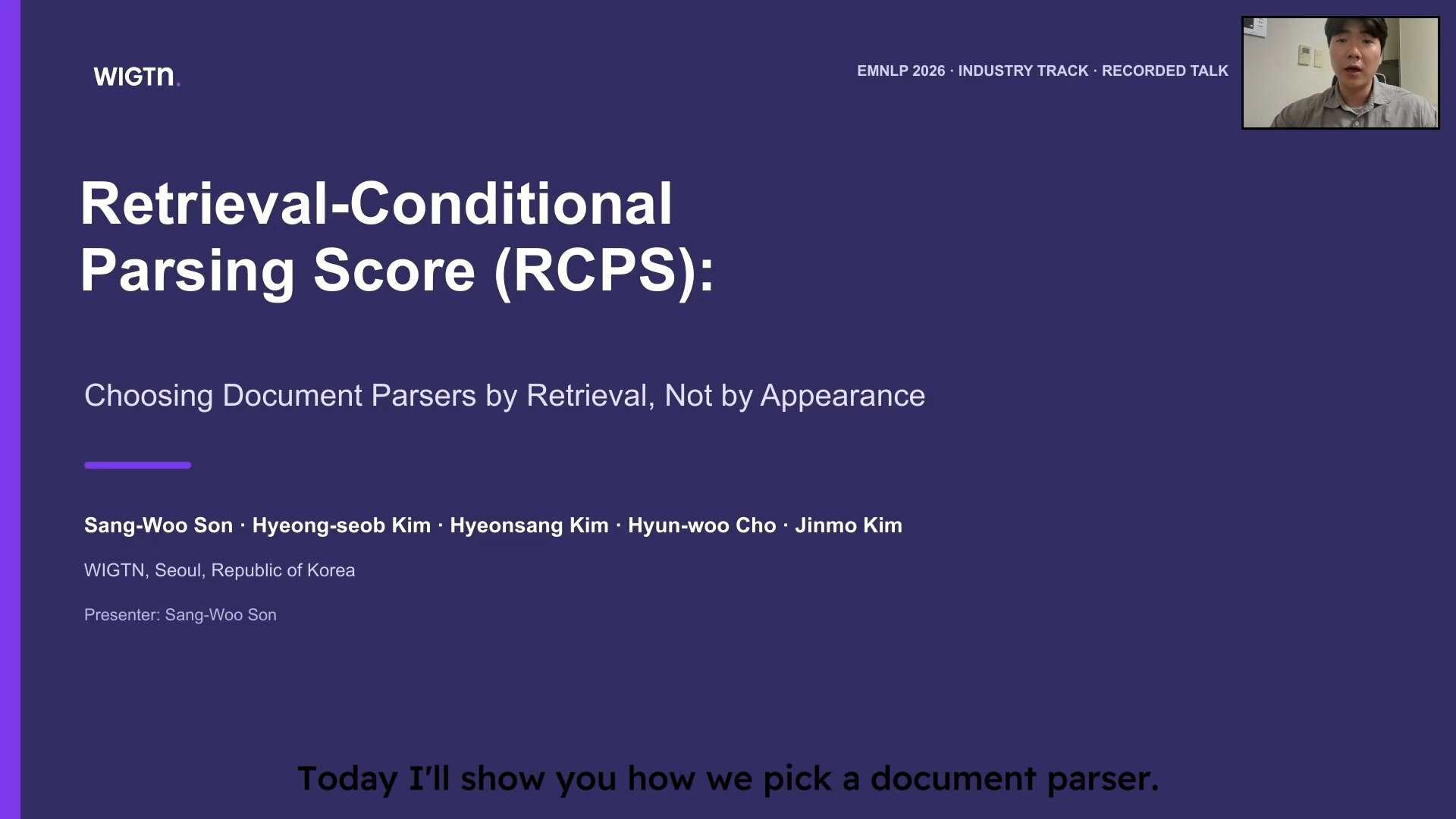
At an in-person poster session the A0 poster would have been printed and carried to the venue; for a virtual one it only had to be uploaded. The talk went in as a 12-minute recording over twelve slides, with the slides full screen and the camera in a small window. Before pressing record we checked every slide for where that window would cover the least, and it went in the top right.
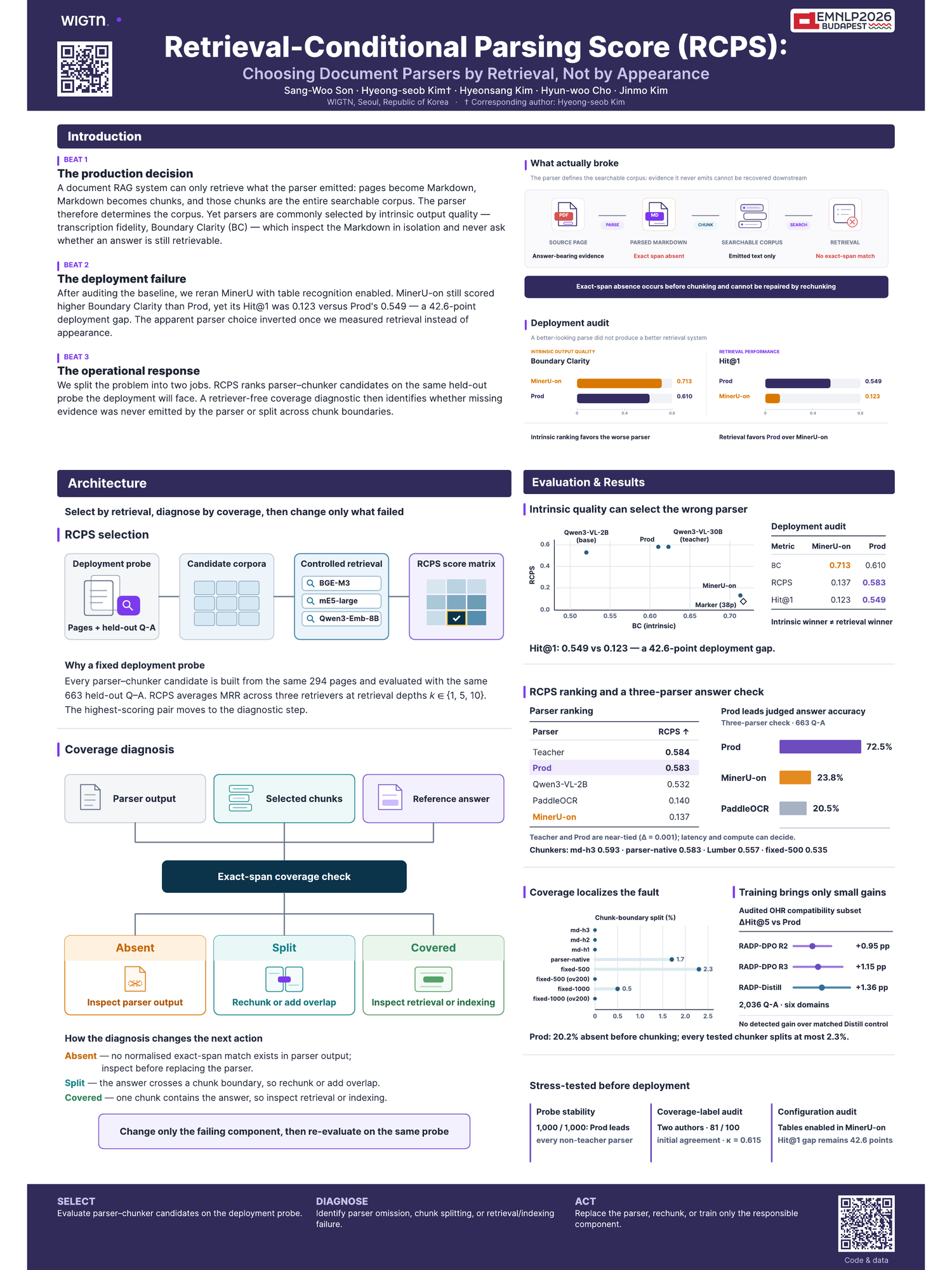
The A0 poster. No print shop and no poster tube this time: it went to Underline as a PDF.
The paper
RCPS started with our own OCR model. WigtnOCR is the parser we run in production, and when we compared it against other parsers, the usual intrinsic score said we had picked the wrong one. MinerU with table recognition turned on looked cleaner, 0.713 Boundary Clarity against our 0.610. Then we checked what actually matters in a search system, whether the first chunk retrieved is the right one, and the order flipped: 0.123 for MinerU against 0.549 for ours.
So the paper proposes choosing a parser by retrieval instead of by how its output looks. The method, the full results and what the evaluation does not cover are in the paper.
Sunday night in Seoul
The session ran on Zoom: one presenter after another, each sharing their own screen. The session host timed every talk and posted a notice in the chat when about two minutes were left. Our turn came at around half past nine Seoul time. Ten minutes, walking the workflow slide from the evaluation frame on the left to the deployment decision on the right.
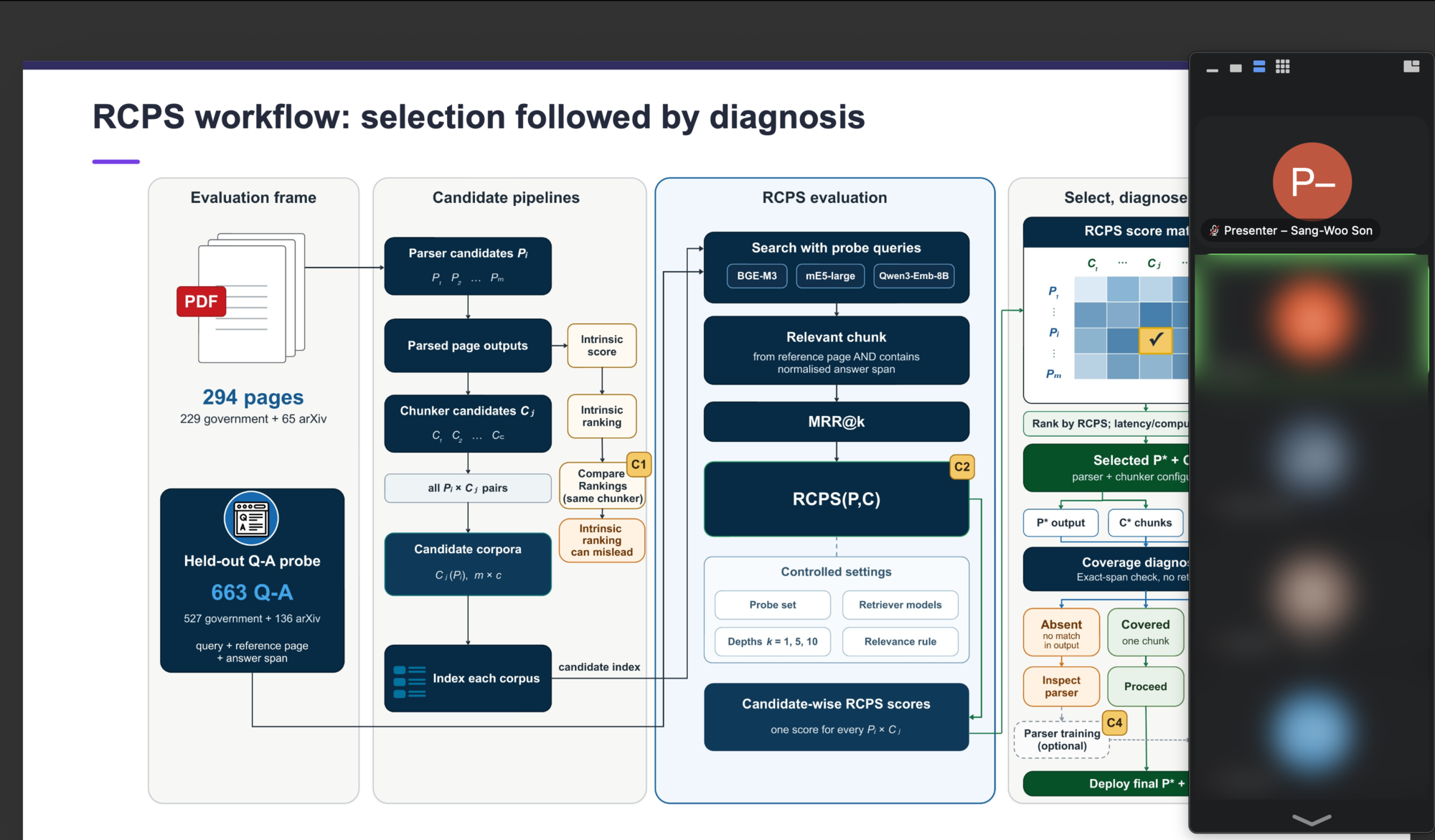
Questions were held until every speaker had finished, for one Q&A at the end of the session. Perhaps because of that format, nobody was quick to unmute and ask, and the Q&A passed without a question for our talk.
Virtual, compared with being there
Three months earlier, at ACL in San Diego, the team ran a booth for three days. Set against that, a virtual session is quieter and more formal. Talks run back to back on a timer, there is no crowd building in front of a screen, and the energy of a room does not come through a laptop.
Networking is the bigger loss. At a booth, the useful conversations start with a stranger who stops to ask what the demo is doing, and in San Diego those conversations were where the next questions came from. A video call has no hallway, and nobody wanders past a tile.
It is efficient, though. No travel, no days away from the work, and the talk exists as a finished recording that anyone can watch later, which a booth never leaves behind. For a paper whose result fits in ten minutes, that trade is reasonable. For a demo that people need to try with their own hands, it would not be.
Thanks to
To the EMNLP 2026 Industry Track Chairs, Pepa Atanasova, Gholamreza Haffari and Minghan Wang, who answered every question we sent them between acceptance and the talk, from the author footnote on the camera-ready to the move to a virtual presentation.
To the Virtual Infrastructure Chairs, Fernando Batista and Ali Hürriyetoğlu, whose virtual track is the reason a team in Seoul could present at a conference in Budapest at all, and to the session host who kept every talk on time.
To the anonymous reviewers. Their questions in July became much of the camera-ready revision, and the paper is better for every one of them.
And to the five people who wrote it: Sang-Woo Son, Hyeong-seob Kim (corresponding author), Hyeonsang Kim, Hyun-woo Cho and Jinmo Kim.
Working on something like this? Let's talk.
Talk to us